Interesting Facts About Red Diamond
Did you know red diamonds are so rare that there are only 30 true gem-quality specimens known to exist globally?
In fact, they are considered the rarest gemstones in the world.
Unlike other diamond counterparts, red diamonds get their red color from pure carbon01.
The red hue is derived from “plastic deformation”, which is a process involving intense structural pressure during formation that makes crystal lattices twisted.
Thereby, these twisted crystal lattices reflect red light02.
Want more amazing facts? – Visit here
Where Red Diamond Comes From
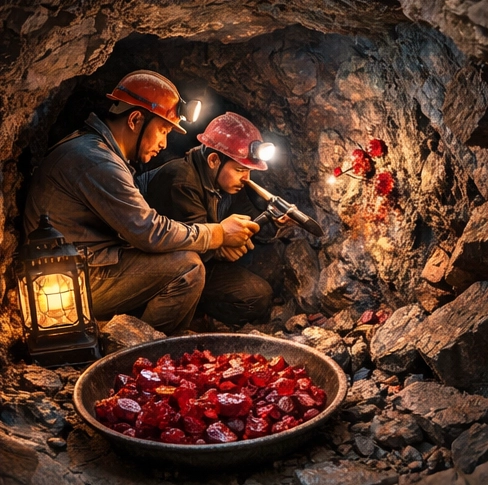
Red diamonds are considered “geological anomalies”.
They are formed around 1.6 million years ago within the Earth’s mantle02.
The uniqueness of the red diamonds is attributed to how they have no chemical impurities.
The origin of red diamonds comes from the rare phenomenon called “plastic deformation”02.
As the diamond ascends to the surface from the deep layers of the Earth, intense pressure and heat cause the crystal lattice to shift and twist03.
The shifting and twisting of the crystal lattices, therefore, cause structural defects that absorb light frequencies.
In this case, the process causes the diamond to reflect a deep, vivid red color.
Red diamonds are characterized by a pure, saturated red hue.
This diamond has no “intensity levels” compared to other color diamonds04.
They are simply graded as “Fancy Red”.
The primary source of red diamonds was the Argyle Mine from Western Australia05.
This location produced around 90% of the world’s supply before it finally closed in 2020.
Other sources can be found in Africa, Brazil, and Russia.
How Red Diamonds are Processed
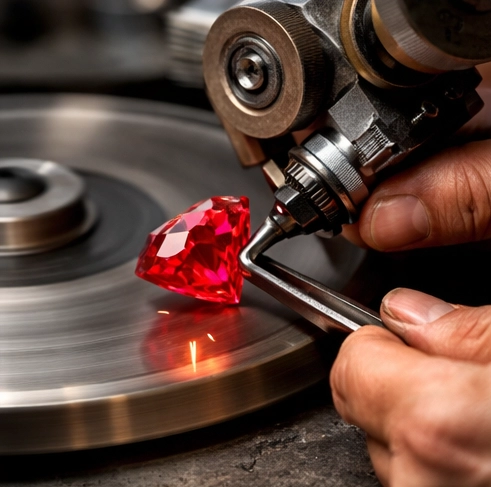
The processing of red diamonds follows a five-step process.
The first step is planning. It involves the usage of 3D scanners for cutters to map the rough stone06.
The second step is cleaving or sawing.
This is where the rough stone is split or sawn through the use of diamond-tipped blades or lasers to remove impurities07.
The third step is bruting. Rotation of two diamonds against each other is done to make a rough circular shape08.
The fourth step is called faceting.
Skilled professionals grind certain facets to specific angles.
Radiant or fancy cuts are more preferred with red diamonds over round cuts.
These enhance the red diamond’s crimson hue as it extends the light path through the stone09.
The fifth and last step is called polishing.
It gives a mirror-like finish to the cut stone through the use of a high-speed wheel10.
Why It Is Expensive and How Rare It Is
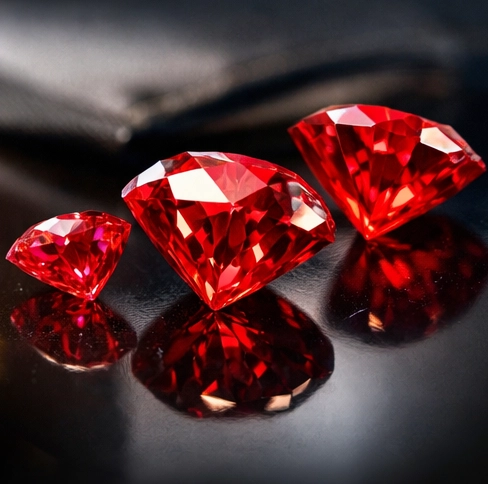
Red diamonds are expensive due to their extreme rarity.
The 2020 closure of the Argyle Mine, which supplies 90% stock of red diamonds, heightened the scarcity. This causes for a “supply shock”.
This means their value skyrockets due to their finite supply11.
Moreover, their red hue comes from the rare phenomenon “plastic deformation” that occurred billions of years ago.
This deviates from other types of colored diamonds, which is because of impurities.
Famous Jewelry Made From Emerald Gemstones
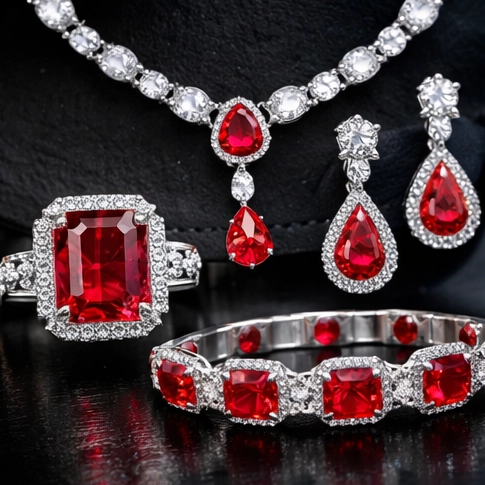
Red diamond jewelries are often bespoke and museum-grade. Some notable pieces are:
- The Moussaieff Ring – It is a 5.11-carat trilliant-cut jewelry. This is the world’s largest known red diamond as of 202612.
- The Kazanjian Red – It is a 5.05-carat emerald-cut red diamond. It is the world’s second-largest red diamond. Its history also adds to its value13.
- The Argyle Phoenix – It is a 1.56-carat round-cut red diamond. It is from the original Argyle Mine, which exudes deep red color14.
Red Diamond’s Market Value (Price per Carat)
The price of red diamonds holds its value per weight. The price typically starts at $1 million per carat15.
Other specimens with pure red saturation can reach prices ranging from $2 million to $5 million per carat16.