Interesting Facts About Blue Diamond
Did you know that blue diamonds are so exceptionally rare that they comprise less than 0.1% of all diamonds mined?
Their blue color comes from trace amounts of boron trapped within the crystal lattice01.
Scientists discovered that blue diamonds form at extreme depths, ranging up to 410 miles beneath the Earth’s surface.
This makes it even deeper than standard white diamonds02.
Want more amazing facts? – Visit here
Where Blue Diamond Comes From
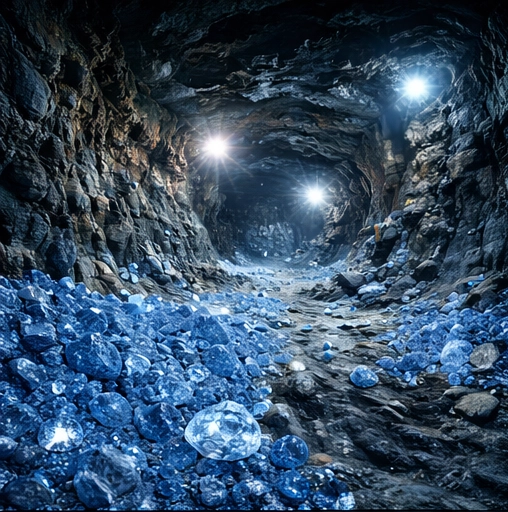
Blue diamonds are known as one of the “superdeep” gems of the world03.
This type of diamond was discovered to be up to extreme depths ranging to 410 miles, which reaches into Earth’s lower mantle.
The blue color of the diamond can be attributed to the trace amounts of boron, which is a rare element found in the mantle but abundant in the Earth’s crust04.
These blue diamonds are known for their sky-to-ocean colors.
Their hues can range from Faint Blue to Fancy VIvid Blue05.
Another unique factor about these gemstones is that blue diamonds are able to conduct electricity due to the boron.
Furthermore, they possess a metallic luster–which makes them showcase secondary gray or violet undertones06.
The primary source of blue diamonds is the Cullinan Mine in South Africa. As of January 2026, there was a recent unearthing of a massive 41.82-carat rough blue diamond07.
This is considered as one of the most significant finds of the decade.
Historically, blue diamonds are also found in the Golconda region in India.
Small quantities were also found in Argyle Mine in Australia08.
How Blue Diamonds are Processed
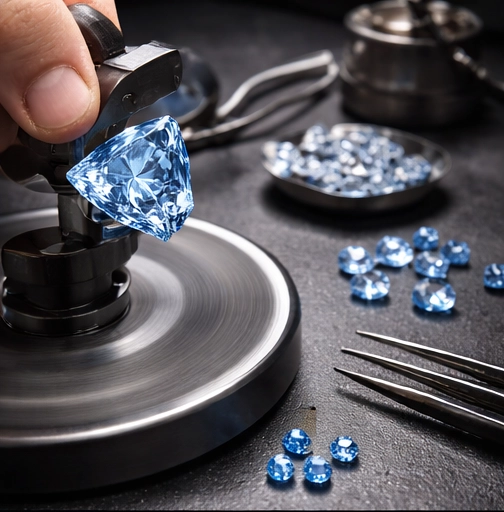
Blue diamonds undergo a rigorous process where it prioritizes color preservation.
The first step is analysis. 3D imaging is used to locate boron-rich zones before cutting it09.
The second step is cutting.
This process uses lasers or diamond-tipped saws for the shaping of the rough stone.
Radiant or cushion cuts are chosen for blue diamonds over round ones.
These cuts have deeper pavilions that bounce light through the stone. This allows longer, saturating blue hues to emit10.
The third step is polishing.
This process involves using wheels coated in diamond dust to polish the gem in 57 to 58 facets10.
In another aspect, there are lab-grown blue diamonds.
Laboratories make these gems by using a high-pressure press (HPHT) or introducing boron gas into a plasma chamber (CVD) to replicate deep-earth conditions11.
Why It Is Expensive and How Rare It Is
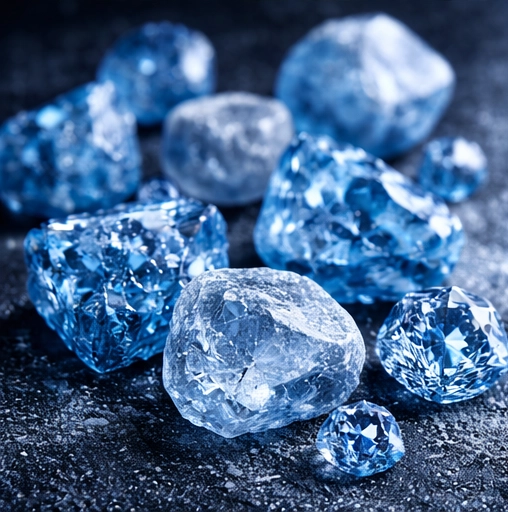
Blue diamonds are expensive due to their extreme scarcity.
They make up less than 0.1% of all diamonds mined.
Their value even heighted due to the closure of the Argyle Mine in 2020, which is one of the key sources of blue diamond.
Furthermore, the demand for Type IIb stones are high as it contains rare boron12.
Famous Jewelry Made From This Gemstone
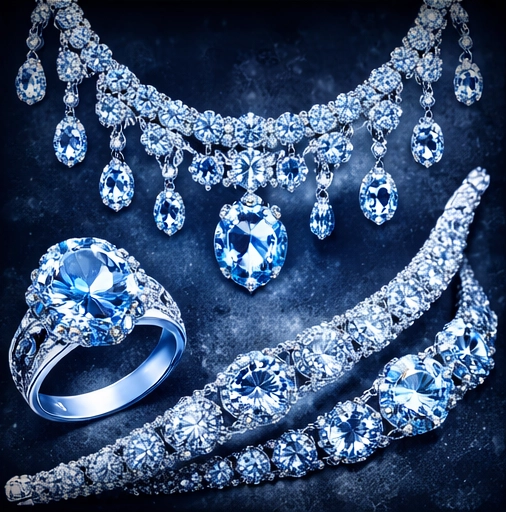
Key examples of blue diamond jewelry often features legendary stones in bespoke or historic settings. Some of them are:
- The Hope Diamond – It is a 45.52-carat cushion-cut gem contained in a platinum pendant. It is surrounded by 16 pear and cushion-cut diamonds13
- The Blue Moon of Josephine – It is a 12.03-carat Fancy Vivid Blue diamond used as an emblem of a stunning ring14
- The Oppenheimer Blue – It is a 14.62-carat emerald-cut stone surrounded by two colorless trapeze-shaped diamonds in a platinum ring15
Blue Diamond’s Market Value (Price per Carat)
Blue diamonds vary in terms of its price depending on their intensity16. Fancy Light Blue stone prices range round $50,000 to $100,000 per carat. Fancy Vivid Blue stones, on the other hand, range around $1 million per carat. For some record-breaking gems such as the Blue Moon of Josephine, it has reached auction prices of over $4 million per carat17.