Interesting Facts About Alexandrite
Did you know that alexandrites are famous for their color-change phenomenon01?
With their color-changing abilities, they are known by their nickname as “emerald by day, ruby by night.”
This gemstone appears vivid green in sunlight, but looks raspberry red under incandescent light02.
It reflects red and green equally, so its appearance depends on the light source entirely.
Want more amazing facts? – Visit here
Where Alexandrite Comes From
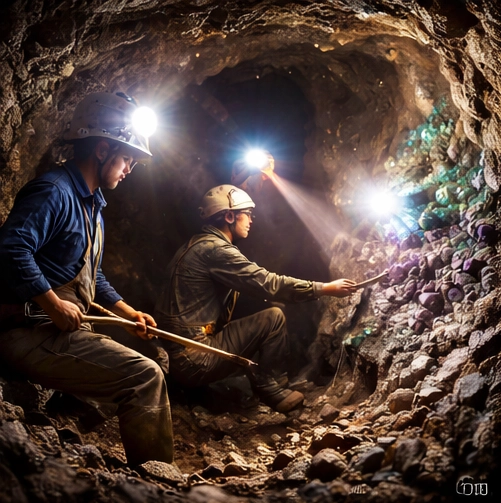
According to the Smithsonian Institution, alexandrite was discovered in 1830 in the Ural Mountains of Russia03.
This gemstone was named after Tsar Alexander II.
Alexandrite became the National Stone of Russia for its green and red hues, which are the colors of Russia’s imperial military.
Description-wise, alexandrite is a variety of chrysoberyl that exudes color-changing properties.
It has the “chameleon” abilities to showcase two different colors under different lights.
This rare optical phenomenon is known as the “Alexandrite Effect”04.
This effect is due to the way chromium absorbs light within the crystal lattice.
This phenomenon is considered “rare” as no other gemstone can replicate it.
In terms of where alexandrites can be found, they are found in different parts of the world, such as Brazil, Sri Lanka, Madagascar, Tanzania, Zimbabwe, India, and Burma05.
The original mines in Russia, however, are already exhausted. As of 2026, natural alexandrite is so scarce that a high-quality, 1-carat stone is more expensive than a 1-carat diamond06.
How Alexandrites are Processed
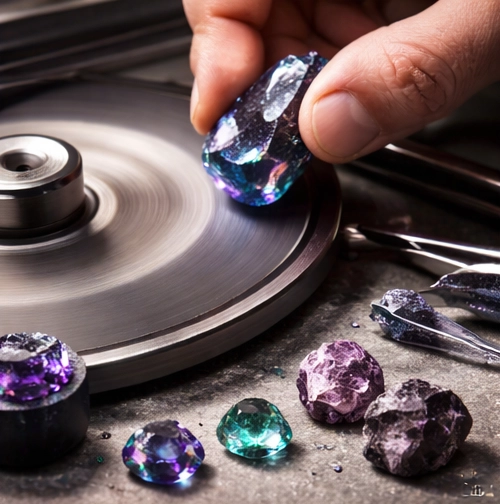
According to Jupiter Gem, the processing of alexandrite involves a sophisticated process that consists of precise lapidary skill and advanced material science07.
It is rare for alexandrites to be subjected to clarity-enhancing treatments (e.g., polishing) common in other gemstones like emeralds. This is because natural alexandrite is both rare and durable. With this, its main process focuses on the master cutter’s ability to manipulate light through orientation.
Alexandrite is pleochroic. It means that it shows different colors in different crystal directions08. The gemstone’s pleochroic abilities pose the most critical challenge in cutting natural alexandrite. The master cutter uses a tool called a dichroscope to determine the stone’s optical axes09. This is to identify which angle showcases the most dramatic color shift.
In terms of the production of lab-grown alexandrites, it utilizes the Czochralski or “pulled” method10. This method involves the melting of raw materials like beryllium, aluminum oxide, and chromium in a high-temperature iridium crucible. Then, a small seed crystal is dipped into the molten mixture. Afterward, it is slowly rotated as it is withdrawn at a rate of two millimeters per hour11.
How Expensive and Rare Alexandrites Are
Alexandrites are expensive and rare. Like emeralds, alexandrites are also “geological miracles” due to the rare meeting of beryllium and chromium, which are elements found in different layers of the Earth. To prevent the formation of emerald, silica must be present in the formation of alexandrite. Furthermore, the natural mines of alexandrites are nearly exhausted, making it rare to find. Thereby, the price of alexandrites is much higher due to their rarity.
Famous Jewelry Made from Alexandrite Gemstones
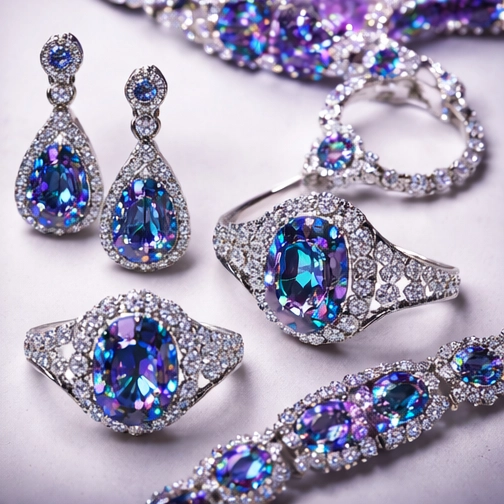
The most famous alexandrite pieces are:
- Whitney Alexandrite – It is a 17.08 carat jewelry piece housed at Smithsonian12
- Imperial Alexandrite Necklace – It is a necklace containing a massive 69.37 carat Russian stone. It is one of the world’s rarest and most expensive jewelry pieces to date 13
Alexandrite’s Market Value (Price per Carat)
Alexandrites are one of the most expensive gemstones in the world. Commercial-grade alexandrites range around $2,000 to $10,000 per carat14. For high-quality natural stones with 80% to 100% color shift, the prices range from $15,000 to $70,000 per carat15. For lab-grown alexandrites, it is relatively cheaper with the prices ranging from $500 to $1,500 per carat according to Bling Advisor16.